Research
005
2025
Nano Factory Futures
WaterBoys explored Nano Factory Futures as a question about what manufacturing becomes when it is designed for community service rather than industrial scale. This research reimagines the Nano Factory — a modular, neighborhood-scale production node — as civic infrastructure: a utility that a community owns and runs to process its own waste into artifacts it actually needs. From surf fins and circular water systems to joinery hardware and bio-material vessels, the research develops a framework for resilient, locally-rooted production that does not compete with the Giga-factory on the Giga-factory's terms.
Track
SERVICE + PRODUCT
Status
Published
Output
WSTED
YEAR
2025
Water - service design - urban systems - circular economy
The Thesis
The central argument of Nano Factory Futures is that the most significant design challenge in distributed manufacturing is not technical — it is structural. The Nano Factory as a concept is not new. Local Motors tried it with vehicles. Arrival tried it with electric vans. Both failed, and both failed for the same reason: they attempted to make local-scale production cost-competitive with centralised industrial scale, which is a race no small system can win. The Nano Factory thesis, as WaterBoys frames it, refuses that competition entirely. It argues instead for a different value frame — one in which resilience, community economic return, material traceability, and local governance are the primary metrics, and cost-per-unit is secondary.
The second argument is equally specific: this is a service design problem, not a hardware problem. The question is not whether the machines exist to process waste into feedstock and fabricate functional objects at small scale. They do — the desktop fabrication ecosystem is mature enough. The question is how a community infrastructure gets designed, governed, and integrated into daily life so that it functions like a library rather than a startup — serving the people in its radius, owned by them, sustained by them, and oriented toward their specific needs rather than toward an external investor's return. That is the design problem Nano Factory Futures explores.
THE MYTH OF AWAY
(The problem statement — what the Giga-factory era built and what it assumed)
For two centuries, industrial civilization operated on a foundational myth: that waste could be sent "Away." The geography of Away — the landfill, the ocean, the atmosphere — was the silent subsidy that made industrial economics legible. Products were cheap because the cost of their disposal was not included in the price. Supply chains were efficient because the fragility embedded in a system spanning multiple continents was not yet visible as a risk.
The Giga-factory was the apex of this model. Massive, centralized, optimized for volume and standardization, it was fundamentally disconnected from the communities and material environments that surrounded it. A shoe factory in a distant country processed leather from another country, shipped finished goods to a third, and left behind a waste stream that belonged to no one's accounting. The geography of Away absorbed the residue. The geography of Away has now collapsed.
Supply chain disruption since 2020 has provided the most direct evidence. The PPE shortage of early 2020 — in which global supply chains for medical face masks failed within days, leaving hospitals in wealthy countries unable to source basic protective equipment — demonstrated that the efficiency of centralized production was inseparable from its fragility. The same logic applied to semiconductors, food, pharmaceutical ingredients, and building materials across the following two years. What had been optimized for normal conditions proved catastrophically inadequate under disruption. The industrial monolith, it turned out, had been externalizing not just the cost of waste disposal but the cost of resilience itself. Communities and nations that had retained local production capacity — however inefficient by industrial metrics — suffered less. The case for local manufacturing was no longer philosophical. It was empirical.
THE FAILURE CASES ARE THE ARGUMENT
(Why previous microfactory attempts failed — and why this framing is different)
Local Motors built a microfactory network for co-designed regional vehicles. The concept was compelling: small factories, close to customers, producing runs of locally co-designed cars. Arrival proposed a global network of small EV manufacturing plants, each producing roughly 10,000 vehicles per year, positioned as a cost-competitive alternative to traditional automotive Gigafactories. Both companies attracted significant capital. Both collapsed.
The failure was not the microfactory concept. It was the economic framing. Both companies positioned local-scale production as a challenger to industrial-scale production on industrial-scale terms — cost per unit, production volume, investor return timeline. Measured against a Gigafactory, a microfactory loses. It will always lose. The economics of scale are real, and competing against them with a smaller version of the same system does not work.
The Nano Factory thesis takes a fundamentally different position. It does not argue that a community workshop can produce surf fins cheaper than a factory in Guangdong. It argues that a community that processes its own waste to produce its own functional objects has gained something that cost-per-unit analysis does not capture: the ability to make what it needs, from what it already has, without depending on a supply chain that may not be there when it needs it. The economics are resilience economics. The value is not efficiency — it is the knowledge that the loop can close locally, that the capacity exists, that it belongs to the community rather than to a distant shareholder.
THE PROOF ALREADY EXISTS
(The COVID maker/Fab Lab response as real-world validation — empirical, not speculative)
In March 2020, global supply chains for medical PPE collapsed within days of COVID-19 being declared a pandemic. Within the same week, the distributed maker and Fab Lab network — a global ecosystem of community fabrication workshops that had been building quietly since the early 2000s — began activating. Research subsequently published in PLOS ONE documented hundreds of makerspaces across every continent producing functional face shields, mask frames, nasopharyngeal swabs, and ventilator components. Millions of units. Without centralised coordination. Without industrial infrastructure. Without a supply chain. Using desktop 3D printers, laser cutters, and the same CNC tools that had been used for hobbyist projects the week before.
The response was imperfect. Quality was variable. Coordination was difficult. Many facilities produced goods that were never used. But the fundamental question — can distributed community manufacturing infrastructure produce functional goods at meaningful scale in response to community need? — was answered definitively. Yes. It can.
The Fab Lab network had been designed as a prototyping resource. Its COVID response revealed that it contained latent production capacity that could be activated in an emergency. The design question the Nano Factory addresses is how to make that activation permanent and intentional rather than emergency and improvised. The capacity already exists in distributed form. What is missing is infrastructure designed from the outset for sustained community production — infrastructure governed for local service, equipped for the material streams that a specific community generates, and integrated into local supply chains so it does not wait for a crisis to become useful.
Physical AI, as it matures through the late 2020s, makes the Nano Factory's automation ambitions increasingly plausible. Desktop fabrication is already capable. Computer vision quality control is accessible. The gap — autonomous material handling for diverse input streams — is narrowing. The machine architecture for a community Nano Factory is not waiting on fundamental research. It is waiting on design.
THE ARCHITECTURE OF HERE
(What the Nano Factory actually is — physical, operational, governed)
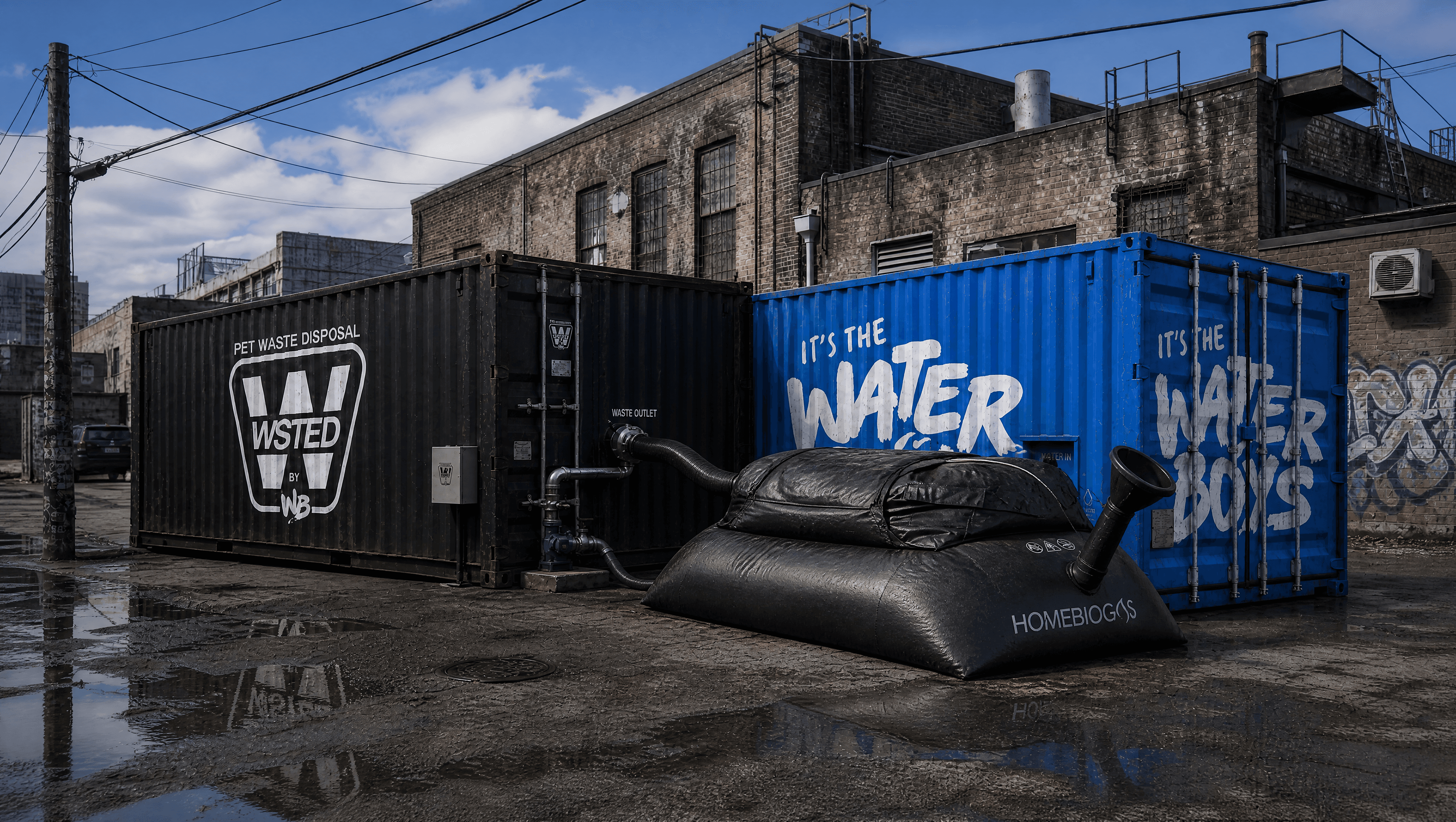
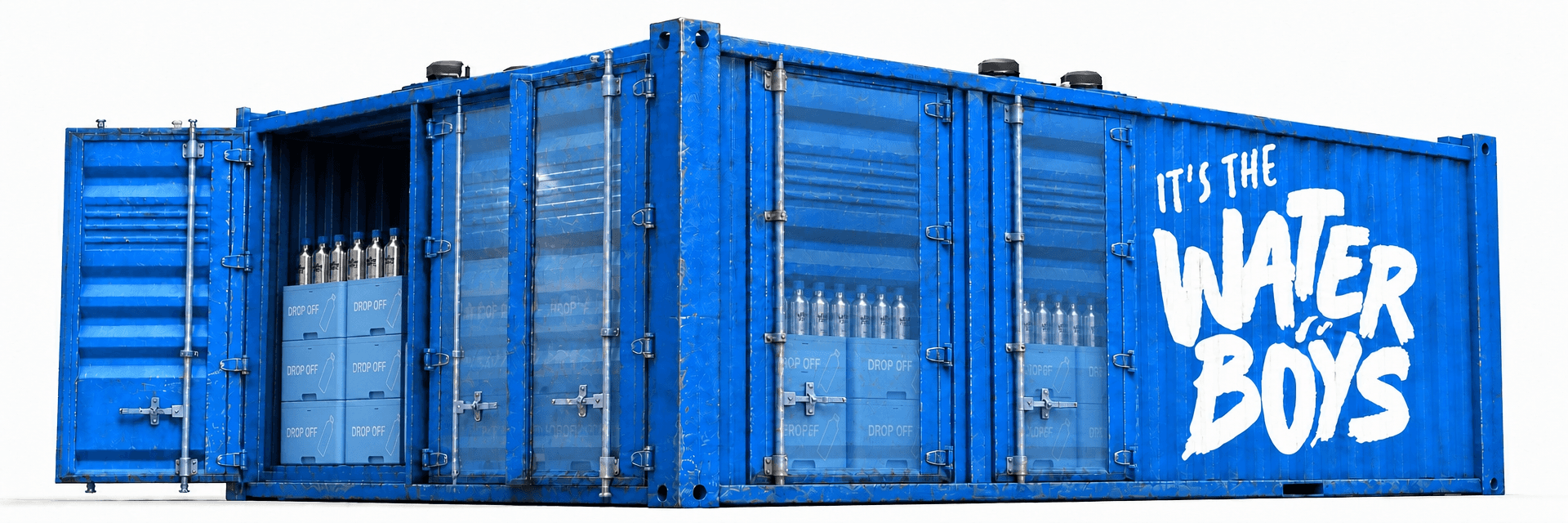
The Nano Factory occupies less than 200 square feet. It uses a standard ISO shipping container or an underused urban storefront as its shell — infrastructure that already exists in abundance in most cities. It is designed for non-destructive deployment: it does not require new buildings, does not modify the urban fabric permanently, and can be relocated to serve a different neighborhood when its current context no longer needs it.
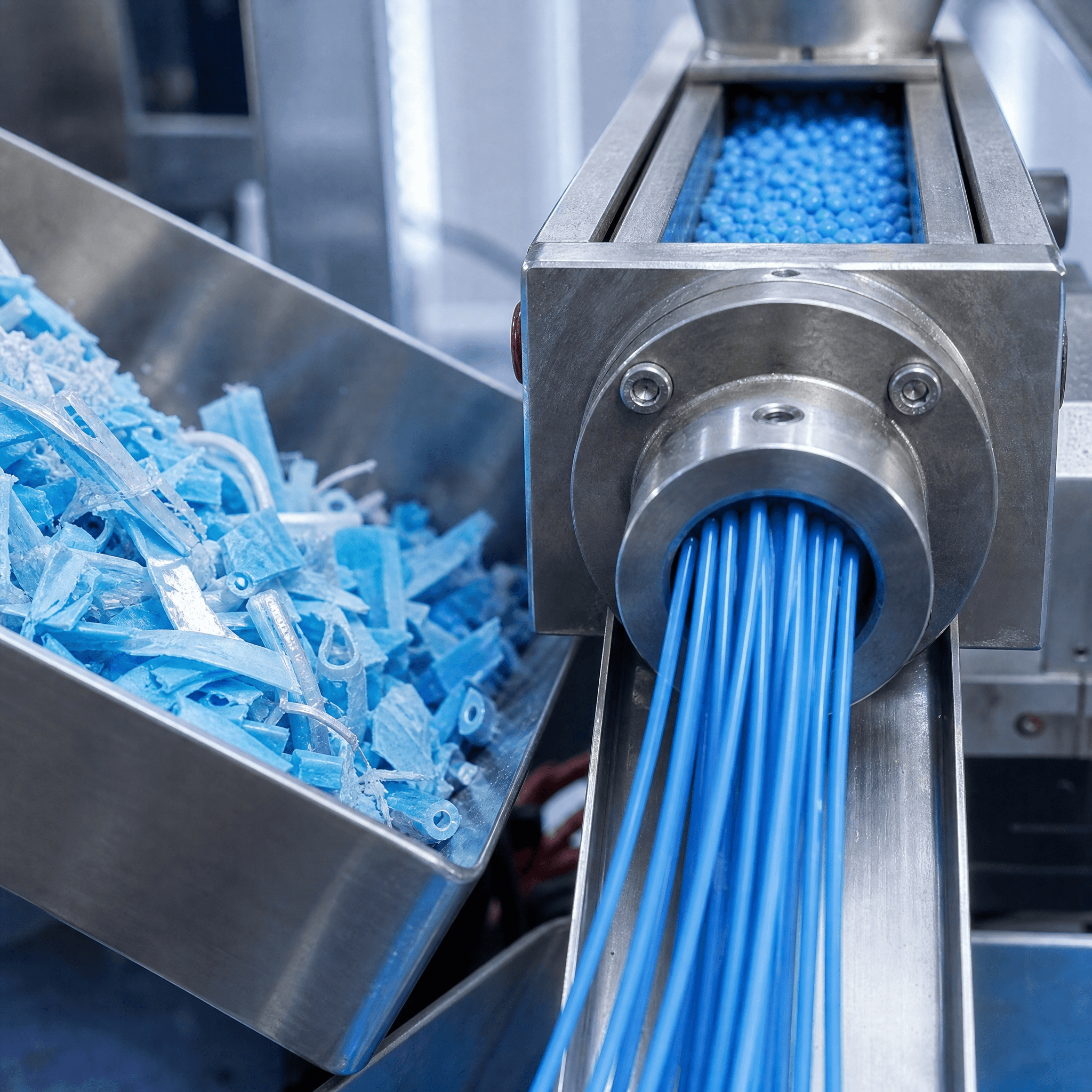
The process engine operates in three stages. The Receptor uses computer vision to sort incoming waste at source — separating PET, HDPE, textile waste, food packaging, and other material streams without requiring the community to perform complex sorting themselves. The Metabolism granulates and processes sorted material into raw feedstock; desktop extruders adjust temperature and toolpath in real-time to account for the specific properties of the day's waste batch. The Synthesis layer — hybrid fabrication combining additive, subtractive, and compositing methods — converts feedstock into designed objects, with generative design tools optimizing geometry from the available material properties rather than imposing fixed specifications on variable inputs.
The governance model is as designed as the machine architecture. A community Nano Factory is not a startup. It does not have investors, and it does not optimize for shareholder return. The models it draws from are libraries, energy cooperatives, and community land trusts — civic infrastructure designed to serve a defined geography, governed by the people who use it, sustained by the value it creates locally. Ezio Manzini's concept of "collaborative services" — infrastructure co-produced by community members rather than delivered by institutions — is the design framework. The Nano Factory is designed to be owned.
THE WATERBOYS ECOSYSTEM
(WaterBoys projects as proof nodes — connecting the thesis to built work)
WaterBoys' own project work is not separate from the Nano Factory thesis. It is its evidence base.
Trash Fins — the surf fins developed through the WB × Rheom collaboration and the Fin Futures research — are the first Nano Factory Value Chain Artifact. Fabricated from waste fiberglass and upcycled resin, with generative lattice structures embedded from community-sourced material, they demonstrate that local waste can produce high-performance functional objects. The fins perform. They are not a concept. They exist, and their existence validates the material logic of the Nano Factory model.
The WaterBoys water service extends the same closed-loop logic to water as a community resource — local intake, local processing, local return. The Studio Chair applies it to furniture: commodity materials sourced locally from hardware stores, elevated by precision joinery hardware that any equipped community workshop could produce. Each project is a proof of the same thesis at a different material scale and a different object type. What connects them is not the material — it is the design position. The WaterBoys layer is not the raw material. The WaterBoys layer is the designed intervention that transforms available material into considered object.
The Nano Factory is the infrastructure that makes this transformation systematic. Not a one-off design experiment, but a permanent, community-owned service that enables the same material transformation to happen continuously, for whatever the community needs most. It is the architecture connecting work that is already in progress.
THE ARCHITECTURE OF HERE
The Nano Factory will not be built by companies that need to compete with Foxconn. It will be built by communities that have decided they would rather make what they need than depend on a supply chain that may not deliver it. That is a different kind of institution, organised around different incentives, designed against different failure modes. It is also a harder kind of institution to design — because it requires the designer to work at the level of governance and service logic, not just machine architecture.
Some things don't need to be everywhere to matter. They need to be here, for these people, doing this specific thing. The question the Nano Factory asks is not whether distributed community manufacturing is possible. It has already demonstrated that it is. The question is who designs the permanent version.